
• Skip to primary navigation
  • Skip to main content
Thrive

Thrive

Evidence based holistic coaching and therapy to unearth what is standing in the way of discovering your best self.

  • Home
  • Meet Us
    • Dr. Hannah Joy Roberts
    • Dr. Sarah Joy Park
    • Ellen M. Jones
    • Laura C. Westmoreland
    • Dr. Heather Lilleston
  • Therapy Services
  • Schedule a Session
  • LGBT+ Resources
  • Blog
  • Contact

Therapy

Dr. Hannah Roberts · March 1, 2024 ·

Queer-Affirming Therapy:

Finding a Safe Space

“It is absolutely imperative that every human being’s

freedom and human rights are respected,

all over the world.”

– Jóhanna Sigurðardóttir

by Gavin Hannegan, Cal Poly, San Luis Obispo undergraduate intern, supervised by Dr. Hannah Roberts

Therapy can be an incredibly rewarding experience, so it is important to find a therapist that you would feel comfortable with. For LGBTQ+ folk, it is even more important to find queer-affirming therapy. The therapist-client relationship can offer a safe space for you to be able to freely express yourself without judgment. The process of finding queer-affirming therapy can feel overwhelming. Some therapists explicitly state that they welcome people of all backgrounds, but other times, the cues can be a bit harder to read. 

Here, I will be offering a few signs to look out for to help you determine if you would feel affirmed by your therapist. As you read, keep in mind that the process of building that trust with your therapist may take time. You might also respond differently to different therapists. There is no rush to feel comfortable right away! 

Your Therapist Is Open to Learn

A common misconception is that an LGBTQ-affirming therapist has to also identify as LGBTQ, but there are plenty of straight or cisgendered therapists who can empathize with your experiences. One theme that emerged in interviews with SLO County residents who attended therapy is that positive experiences with therapists occurred when the therapist were willing to learn more about LGBTQ identities, regardless of if the therapist identified as LGBTQ or not (Bettergarcia et al., 2021). A therapist might ask you some questions about your identity to better understand your perspective. It is also okay for you to educate your therapist when the opportunity arises. Here are some examples:

  • “I actually go by this name, and I use these pronouns.”
  • “No, I haven’t really felt that way. I feel more like this…”
  • “That term is a little outdated, it’s more appropriate to say this…”

You are well within your right to correct your therapist and explain how that made you feel. However, it is not your job to teach your therapist everything about how to effectively work with the LGBTQ+ population; the therapist may need to do some homework and develop their knowledge outside of the session.

Your Therapist Actively Validates Your Identities

An active effort on the part of the therapist is key. In their research, Anzani et al. (2019)

distinguish between passive forms of affirmation towards trans people (i.e., not using microaggressions) and active forms of affirmation (i.e., encouraging gender exploration). While both forms can be helpful, Anzani et al. (2019) recommend that therapists strive to be actively affirming in order to help their clients navigate the cisnormativity that exists within society. Active validation looks like:

  • Your therapist connecting you to local groups and resources
  • Your therapist using the correct name and pronouns before, during, and after transitioning
  • Your therapist treating your identities as normal and authentic

In other words, an affirming therapist should do more than the bare minimum. When meeting with your therapist, you can ask them directly how they will actively validate your LGBTQ+ identities. If this feels too forward, you can also take note of how your therapist responds to LGBTQ+ issues. Do they simply acknowledge homophobia or transphobia or do they work with you to develop tactics to combat these prejudices? 

Your Therapist Treats You As An Individual, Rather Than a Representative of Your Identity

The ways in which you experience your identities might not be the same ways that other queer folk experience their identities. If a therapist generalizes these experiences as representative of the broad LGBTQ+ community (i.e., “All gay people experience…”), then they might be missing some important details. For starters, the label of LGBTQ+ encompasses many different identities. In one survey, mental health clinicians reported that even though they might be affirming of lesbian, gay, and bisexual clients equally, they actually perceive themselves to be more competent when treating lesbian and gay clients compared to bisexual clients (Ebersole et al., 2018). Each of these distinct identities can bring unique experiences–on top of the unique experiences that each individual already has! Again, you are more than welcome to correct your therapist if they make a generalization, but don’t feel responsible for teaching your therapist about the diversity of LGBTQ+ identities. You might also encourage your therapist to adopt a multicultural approach and to consider the interplay of multiple identities. Keefe et al. (2023) found that racial and ethnic minorities who also identified as LGBQ responded best to mental health programs that emphasized the minority stress model, compared to those that did not implement this model. In other words, racial and ethnic minorities may be subject to discrimination based on race and discrimination based on LGBTQ+ status, so your therapist should account for each of these influences. 

One last note: your reasons for attending therapy might not even be related to your gender or sexual identity. While affirming therapists should not outright ignore your identities, it may not be necessary for your therapist to always attribute certain topics to your gender identity or sexual orientation. These identities are just a few aspects of who you are. Remember that this is your journey, and you deserve to feel respected and affirmed in the ways that feel most comfortable to you. 

Feel like you want your therapist to have more information? Here’s a blog post that features the same tips, but directed specifically towards those in the helping profession.

Have more questions or feel like you need queer-affirming therapy? Schedule a session with one of our therapists today! You can schedule online here!

We hope you enjoyed this blog post! Have more topics you’d like us to blog about? Contact us and we’ll be sure to include your topic in a future post!

References

Anzani, A., Morris, E. R., & Galupo, P. (2019). From absence of microaggressions to seeing authentic gender: Transgender clients’ experiences with microaffirmations in therapy. Journal of LGBT Issues in Counseling, 13(4), 258-275. https://doi.org/10.1080/15538605.2019.1662359

Bettergarcia, J., Wedell, E., Shrewsbury, A. M., & Thomson, B. R. (2021). “There’s a stopgap in the conversation”: LGBTQ+ mental health care and community connection in a semi-rural county. Journal of Gay & Lesbian Mental Health, 26(1), 48-75. https://doi.org/10.1080/19359705.2021.1900973

Ebersole, R. C., Dillon, F. R., & Eklund, A. C. (2018). Mental health clinicians’ perceived competence for affirmative practice with bisexual clients in comparison to lesbian and gay clients. Journal of Bisexuality, 18(2), 127-144. https://doi.org/10.1080/15299716.2018.1428711

Keefe, J. R., Rodriguez-Seijas, C., Jackson, S. D., Bränström R., Harkness, A., Safren, S. A., Hatzenbuehler, M. L., & Pachankis, J. E. (2023). Moderators of LGBQ-affirmative cognitive behavioral therapy: ESTEEM is especially effective among Black and Latino sexual minority men. Journal of Consulting and Clinical Psychology, 91(3), 150-164. https://doi.org/10.1037/ccp0000799

Dr. Hannah Roberts · February 1, 2018 ·

Beginning 2018: Updates from Thrive SLO

Checking In

Wow! It’s already February of 2018! How was your first month of the year? Did you try anything different? Any resolutions or intentions that you started the year with? How did it go? Now is a perfect time to step back and review your work of the past month to see what worked well and what you might want to readjust. We took a one-month media fast while we were hard at work behind the scenes (in both our personal lives, as well as as psychologists at Thrive). And it was the best thing we could have done! We are so excited for 2018 and we’re finally feeling ready to share a few updates with you! Here are a few things happening in 2018:

Our Space

We are loving our little office suite on Monterey and California! We can’t believe that we’ve already been there for 9 months and it is finally feeling like home. We couldn’t have a better neighbor than Juli at Savvi Spa and the space feels fresh and healing. Sometime soon we’ll have an open house so you all can stop by!

Types of Therapy and Coaching

You may not have realized, but we have some pretty unique ways that we support our clients. Not only do we offer traditional, one-on-one counseling in our lovely office (see above), but as psychologists, we also meet with counseling clients from all over California via secure, online video sessions, and we can coach virtually anyone anywhere in the world through that option. We also continue to offer nature therapy sessions throughout SLO County for a select number of clients.

Adding to Our Hours

We now have appointments available weekdays, weeknights, and weekends. Dr. Roberts and Dr. Park have each extended their hours for Thrive clients as the practice has grown and both have openings for a few new clients this month.

Adding to Our Team

We are thrilled to be bringing on Dr. Lisa Slover as a Psychological Assistant. Dr. Slover will be focusing on working with adolescents and their families, as well as with new moms, especially those experiencing postpartum anxiety and depression. You’ll be hearing more from her soon. While Dr. Slover is working toward her license as a psychologist, she will be supervised by Dr. Roberts and Dr. Park and will also be able to see clients at a reduced fee. Feel free to contact us if you would like to schedule now.

Adding to Our Services

All of our providers are now seeing adolescents (14 & up), college students, and adults. We work with men and women from all walks of life. We offer inclusive services with an emphasis on cultural humility and specialize in supporting members of the LGBTQ community and their families. We now offer one free session for trans individuals needing a support letter for gender affirming services, as we feel this is an important way to give back to our community.

Adding Online Scheduling

Ok, we’ll admit it: We’re Millennials (or Xennials…), so we prefer that scheduling be easy and streamlined for your lives and ours! We’ve now added the option for new and current clients to schedule appointments online. No more phone tag, where you call us and leave a message while we are in session, just so we end up calling you back while you are busy with your life! Although, we absolutely can still schedule the old-school way if that works better for you!

What’s Next?

We have all kinds of ideas cooking for online classes and support groups and local collaborations! We love how starting our own practice has allowed us to get as creative as we can to better support you! And we want to hear from you: How can we help you thrive in your own life? Is there something you’ve been looking for? Is there something we can offer? We’ll be doing some polling on our Instagram Stories over the next few weeks, but feel free to comment on this post or drop us a line and share your thoughts anytime!

Let’s make 2018 our year to thrive!!

Love,

Dr. Hannah & Dr. Sarah

Dr. Hannah Roberts · March 30, 2017 ·

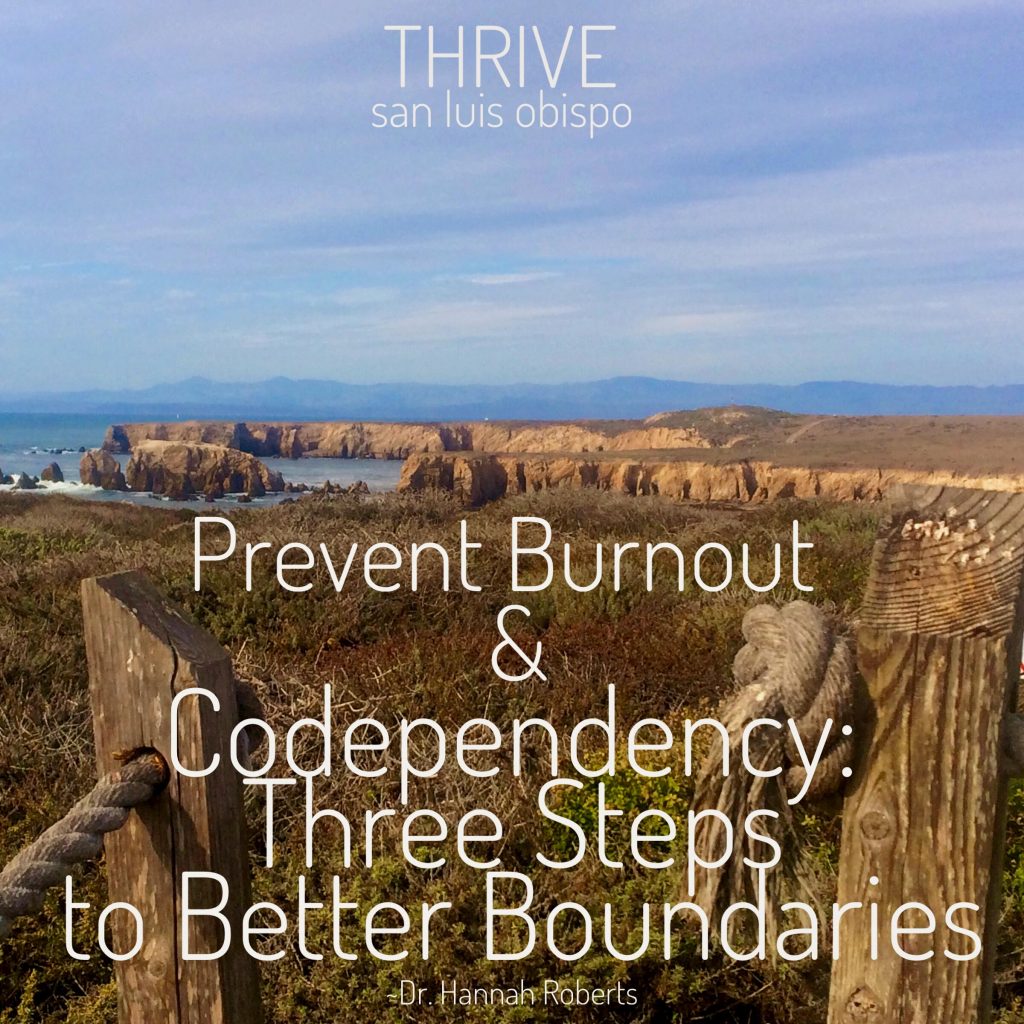
Boundaries are a good thing.

I love to say “yes!” Enthusiastically. And often.

Need help with a project? Sure! Going on an adventure? Yes, please! Need an extra hand? Happy to help! Reading an interesting book in book club? Count me in!

Nothing makes me happier than saying “yes” – there are so many interesting opportunities out there! I am a connector by nature: I feel good when I am helping others. I love feeling like I’m giving back and sharing the abundance of enthusiasm and curiosity life has blessed me with.

However, I’ve found that the more things I say yes to, the more likely I am to feel overwhelmed. I end up perpetually running late and feeling guilty. Eventually, I find myself tired, cranky, and exhausted. This occasionally results in a tearful breakdown; canceling plans; catching that cold that’s going around; or worse (for me) getting irritable and inpatient with those I love. One of the worst symptoms of burnout is losing touch with your empathy and no longer caring about the people and things that were once important to you.

And I know I’m not the only one. Much of my work as a psychologist in San Luis Obispo has been with clients, especially women, discovering boundaries for the first time. I have seen women go on dates, and continue sexual relationships because:

“I can’t let him down.”

“I don’t want to hurt him.”

“I’m not really sure what I do want.”

I have seen women (and men) take on extraordinary workloads in the office saying:

“I can’t disappoint anyone.”

“I don’t want to seem like I’m not pulling my weight.”

“I can’t let my team down – they are counting on me.”

So many individuals are exhausting themselves, wearing themselves thin, and at times, putting themselves in uncomfortable situations because they do not feel comfortable saying “no.” Our culture has not only glorified “being busy” but it has created generations of women that feel they can’t express themselves, can’t be honest about their feelings or their energy level, and most certainly, can not say “no.” This creates codependent relationships, burnout on the job, and overall soul fatigue.

“Setting boundaries is challenging for most people. It’s especially challenging for holistically inclined women, because we tend to want to merge and connect – with everything. For some of us, learning to set healthy boundaries will be the undertaking of our lifetime, the ultimate work of self-reverence”                   ~Danielle LaPorte, White Hot Truth

In Need of Better Boundaries

What I continue to work on, with my clients in therapy and also within my own internal dialogue, is continuous gentle reminders that boundaries are good. Boundaries are protective, they are healthy, and ultimately, maintaining boundaries is the respectful and kind thing to do.

If you let your supervisor know that you are overwhelmed on project A and really need to give it a good solid week of undivided attention before you move on to project B, they will appreciate your clarity and focus. If you tell your book club you can’t make it, as you were so looking forward to that yoga workshop Friday, but you’ll happily host next month, they’ll be looking forward to that. And if you tell Mr. super sweet, but not right for you that you don’t really see where things are going and you’re not interested in dragging things out, he gets to move on and find someone who is actually a better fit sooner.

Boundaries are good for me and they are good for the people I interact and communicate with. If I care about something, I want to be able to give it 100% of my attention. And while there is always so much to enjoy in life, I’ll never get through all of it, so I’d rather focus with clarity on the top choices.

Three Ways to Set Clear Boundaries:

  1. Set a schedule and stick to it. Bonus step: Let those around you know about your new and improved schedule and that you will be following it with no exceptions. Then no one is surprised when you hold your boundary. As I was actively working to change my relationship to my work and to set clear boundaries around my time, I began to share my process with my colleagues, who then became my cheerleaders.
  2. Remember that when you say no to one thing, you are saying yes to something else! Each time you say “no” aloud, gently whisper to yourself what this no allows you to say “yes” to. Make a list in your planner each week of what your priorities are and hold those things sacred. Putting your yeses first allows you to be clear about what might need a boundary.
  3. Most of us have a hard time using negative language. And many people have negative reactions to negative language. Instead of “no”, you could try using positive language instead. Try something like “here’s what I can do…” Be clear in your communication.

Get Support!

Often, setting boundaries takes multiple attempts, especially if there are people in your life that do not respect healthy boundaries. If this is something you’ve been struggling with, know that therapy can be a great place to safety practice boundaries. You can try on different ways of saying things, explore the areas that feel in need of boundaries, and even develop your list of priorities. This is an area where most of us need support! Is there a strategy that has been particularly helpful for you? We’d love to hear it! Please share your ideas in the comments below!


  • « Go to Previous Page
  • Page 1
  • Page 2
"My mission in life is not merely to survive, but to thrive; and to do so with some passion, some compassion, some humor, and some style."
~Maya Angelou

Thrive

Copyright © 2025 · Thrive - San Luis Obispo · Log in