
• Skip to primary navigation
  • Skip to main content
Thrive

Thrive

Evidence based holistic coaching and therapy to unearth what is standing in the way of discovering your best self.

  • Home
  • Meet Us
    • Dr. Hannah Joy Roberts
    • Dr. Sarah Joy Park
    • Ellen M. Jones
    • Laura C. Westmoreland
    • Dr. Heather Lilleston
  • Therapy Services
  • Schedule a Session
  • LGBT+ Resources
  • Blog
  • Contact

SLO Psychologists

Dr. Hannah Roberts · April 4, 2024 ·

Accessing Therapy Beyond Crisis Situations

“When we are no longer able to change a situation,

we are challenged to change ourselves.”

~Viktor E. Frankl

by Gavin Hannegan, Cal Poly, San Luis Obispo undergraduate intern, supervised by Dr. Hannah Roberts

There’s a misconception that therapy should be complete once you start “feeling better.” It’s important to recognize your progress, but there shouldn’t be a deadline to feel your best. Mental health is complex, and oftentimes, your progress doesn’t follow a linear fashion. One week, you might feel stable and secure, and then the next week, you might feel like you fell a few steps back. Don’t worry, these ups and downs are perfectly normal. But what if you’ve been “feeling better” for months, or even years? Or, what if you’ve never had a mental health crisis? Therapy can still be a valuable resource! No matter your background or previous experiences, you are deserving of this kind of care. 

Here are 3 reasons for considering therapy beyond the context of a crisis:

#1: The Brain Doesn’t Function Properly While Under Distress

Chronic stress can make your body feel like it is in a never-ending fight-or-flight state. This is because of how chronic stress delays two important parts of the brain: the prefrontal cortex and the neurotransmitter GABA. The prefrontal cortex is responsible for processes such as cognitive planning and self-regulation, while GABA produces a calming effect meant to counteract stress. Because of these delays, traumas or other ongoing adversities can impair daily functioning. For example, those who experience such stressors have significant declines in working memory, a component of short-term memory that allows you to actively process information. As we age, our working memory skills decrease naturally, but chronic stress accelerates this process (Gandy et al., 2024). COVID-19 has contributed to global increases in chronic stress, which has subsequently produced similar accelerated aging effects in adolescents (Gotlib et al., 2022). Our bodies are not equipped to handle such extreme amounts of stress in small amounts of time, which can increase the risk of cognitive and health-related deficits.

Therapy can help us navigate these stressors by providing coping strategies. However, deficits in working memory impair the learning of these strategies, and delays in the prefrontal cortex and the firing of GABA impair the proper use of these strategies. This is not to say that therapy wouldn’t be helpful to someone actively experiencing a crisis. Rather, you don’t need a crisis to justify therapy. In fact, you might be more receptive to these strategies if they are learned before a crisis emerges.

#2: Therapy Can Be a Protective Measure Against Future Mental Health Crises

It’s never too early to consider therapy. We may not be able to predict when we will encounter another crisis, but we can take action to better prepare ourselves for one. This doesn’t mean that you need to be in therapy for the rest of your life. But attending therapy even when you feel stable can help you maintain that stability over time. One way that therapy operates as a maintenance tool is by teaching skills such as mindfulness, which can help reduce symptoms of anxiety and depression (Eilert et al., 2021). Your therapist can work with you to develop mindfulness strategies that fit best for you. These can include daily affirmations, breathing exercises, or meditations. Additionally, compared to brief forms of therapy (~6 months), long-term therapy, which we often prefer at Thrive SLO (~3 years), is slightly more effective in reducing depressive symptoms and improving daily functioning (Knekt et al., 2016). For some individuals, short-term therapy may not be enough time to implement maintenance strategies and measure their effects, especially for those who are only focused on overcoming a chronic stressor. There isn’t necessarily an ideal length of therapy; it depends on the goals that you set with your therapist. You might have multiple short-term goals (e.g., wanting to be social at an upcoming party) or one overarching goal (e.g., adjusting to daily life after an unexpected loss). Each step you take towards reaching these goals can have a strong positive impact on your well-being, and the lessons you learn can be applied to new goals or concerns.

#3: Long-term Therapy Gives You More Time to Build an Alliance With Your Therapist

Another valuable aspect of therapy is that you have someone to talk to who knows you well. Someone who is unbiased, who recognizes your potential, and who encourages your personal growth. In one meta-analysis that reviewed over 30,000 therapy clients, the relationships those clients had with their therapists were consistently associated with positive outcomes such as symptom reduction (Flückiger et al., 2018). Your therapist can be a consistent form of support. Even having one such person in your life can make a difference. 

As with many other kinds of relationships, though, it can take some time for you and your therapist to form a close bond. You may be hesitant to be vulnerable to a new person in your life, while your therapist has to adapt to your level of comfort with certain topics or situations. If you’re experiencing a crisis, then your typical responses to these topics may be exaggerated or distorted. You could be more on edge, less willing to disclose personal information, or you could be more likely to think irrationally. As a result, there could be misinterpretations between the two of you that can threaten the therapeutic alliance. By spending more time with your therapist, they will have more opportunities to learn about who you are outside the context of a crisis situation. Remember that crises are temporary, and the skills you develop with your therapist can help protect you not just against the crisis you’re currently facing, but also against many other future challenges. There is no concern too small for therapy.

Have more questions or feel like you need supportive therapy? Schedule a session with one of our therapists today! You can schedule online here!

We hope you enjoyed this blog post! Have more topics you’d like us to blog about? Contact us and we’ll be sure to include your topic in a future post!

References

Eilert, N., Wogan, R., Adegoke, A., Earley, C., Duffy, D., Enrique, A., Palacios, J., Timulak, L., & Richards, D. (2023). The relationship between posttherapeutic cognitive behavior therapy skills usage and follow-up outcomes of internet-delivered cognitive behavior therapy. Journal of Clinical Psychology, 79(1), 55-67. https://doi.org/10.1002/jclp.23403

Flückiger, C., Del Re, A. C., Wampold, B. E., & Horvath, A. O. (2018). The alliance in adult psychotherapy: A meta-analytic synthesis. Psychotherapy, 55(4), 316-340. https://doi.org/10.1037/pst0000172

Gandy, H. M., Holis, F., Hernandez, C. M., & McQuail, J. (2024). Aging or chronic stress impairs working memory and modules GABA and glutamate gene expression in prelimbic cortex. Frontiers in Aging Neuroscience, 15. https://doi.org/10.3389/fnagi.2023.1306496

Gotlib, I. H., Miller, J. G., Borchers, L. R., Coury, S. M., Costello, L. A., Garcia, J. M., & Ho, T. C. (2023). Effects of the COVID-19 pandemic on mental health and brain maturation in adolescents: Implications for analyzing longitudinal data. Biological Psychiatry Global Open Science, 3(4), 912-918. https://doi.org/10.1016/j.bpsgos.2022.11.002

Knekt, P., Virtala, E., Härkänen, T., Vaarama, M., Lehtonen, J., & Lindfors, O. (2016). The outcome of short- and long-term psychotherapy 10 years after start of treatment. Psychological Medicine, 46(6), 1175-1188. https://doi.org/10.1017/S0033291715002718

Dr. Hannah Roberts · March 1, 2024 ·

Queer-Affirming Therapy:

Finding a Safe Space

“It is absolutely imperative that every human being’s

freedom and human rights are respected,

all over the world.”

– Jóhanna Sigurðardóttir

by Gavin Hannegan, Cal Poly, San Luis Obispo undergraduate intern, supervised by Dr. Hannah Roberts

Therapy can be an incredibly rewarding experience, so it is important to find a therapist that you would feel comfortable with. For LGBTQ+ folk, it is even more important to find queer-affirming therapy. The therapist-client relationship can offer a safe space for you to be able to freely express yourself without judgment. The process of finding queer-affirming therapy can feel overwhelming. Some therapists explicitly state that they welcome people of all backgrounds, but other times, the cues can be a bit harder to read. 

Here, I will be offering a few signs to look out for to help you determine if you would feel affirmed by your therapist. As you read, keep in mind that the process of building that trust with your therapist may take time. You might also respond differently to different therapists. There is no rush to feel comfortable right away! 

Your Therapist Is Open to Learn

A common misconception is that an LGBTQ-affirming therapist has to also identify as LGBTQ, but there are plenty of straight or cisgendered therapists who can empathize with your experiences. One theme that emerged in interviews with SLO County residents who attended therapy is that positive experiences with therapists occurred when the therapist were willing to learn more about LGBTQ identities, regardless of if the therapist identified as LGBTQ or not (Bettergarcia et al., 2021). A therapist might ask you some questions about your identity to better understand your perspective. It is also okay for you to educate your therapist when the opportunity arises. Here are some examples:

  • “I actually go by this name, and I use these pronouns.”
  • “No, I haven’t really felt that way. I feel more like this…”
  • “That term is a little outdated, it’s more appropriate to say this…”

You are well within your right to correct your therapist and explain how that made you feel. However, it is not your job to teach your therapist everything about how to effectively work with the LGBTQ+ population; the therapist may need to do some homework and develop their knowledge outside of the session.

Your Therapist Actively Validates Your Identities

An active effort on the part of the therapist is key. In their research, Anzani et al. (2019)

distinguish between passive forms of affirmation towards trans people (i.e., not using microaggressions) and active forms of affirmation (i.e., encouraging gender exploration). While both forms can be helpful, Anzani et al. (2019) recommend that therapists strive to be actively affirming in order to help their clients navigate the cisnormativity that exists within society. Active validation looks like:

  • Your therapist connecting you to local groups and resources
  • Your therapist using the correct name and pronouns before, during, and after transitioning
  • Your therapist treating your identities as normal and authentic

In other words, an affirming therapist should do more than the bare minimum. When meeting with your therapist, you can ask them directly how they will actively validate your LGBTQ+ identities. If this feels too forward, you can also take note of how your therapist responds to LGBTQ+ issues. Do they simply acknowledge homophobia or transphobia or do they work with you to develop tactics to combat these prejudices? 

Your Therapist Treats You As An Individual, Rather Than a Representative of Your Identity

The ways in which you experience your identities might not be the same ways that other queer folk experience their identities. If a therapist generalizes these experiences as representative of the broad LGBTQ+ community (i.e., “All gay people experience…”), then they might be missing some important details. For starters, the label of LGBTQ+ encompasses many different identities. In one survey, mental health clinicians reported that even though they might be affirming of lesbian, gay, and bisexual clients equally, they actually perceive themselves to be more competent when treating lesbian and gay clients compared to bisexual clients (Ebersole et al., 2018). Each of these distinct identities can bring unique experiences–on top of the unique experiences that each individual already has! Again, you are more than welcome to correct your therapist if they make a generalization, but don’t feel responsible for teaching your therapist about the diversity of LGBTQ+ identities. You might also encourage your therapist to adopt a multicultural approach and to consider the interplay of multiple identities. Keefe et al. (2023) found that racial and ethnic minorities who also identified as LGBQ responded best to mental health programs that emphasized the minority stress model, compared to those that did not implement this model. In other words, racial and ethnic minorities may be subject to discrimination based on race and discrimination based on LGBTQ+ status, so your therapist should account for each of these influences. 

One last note: your reasons for attending therapy might not even be related to your gender or sexual identity. While affirming therapists should not outright ignore your identities, it may not be necessary for your therapist to always attribute certain topics to your gender identity or sexual orientation. These identities are just a few aspects of who you are. Remember that this is your journey, and you deserve to feel respected and affirmed in the ways that feel most comfortable to you. 

Feel like you want your therapist to have more information? Here’s a blog post that features the same tips, but directed specifically towards those in the helping profession.

Have more questions or feel like you need queer-affirming therapy? Schedule a session with one of our therapists today! You can schedule online here!

We hope you enjoyed this blog post! Have more topics you’d like us to blog about? Contact us and we’ll be sure to include your topic in a future post!

References

Anzani, A., Morris, E. R., & Galupo, P. (2019). From absence of microaggressions to seeing authentic gender: Transgender clients’ experiences with microaffirmations in therapy. Journal of LGBT Issues in Counseling, 13(4), 258-275. https://doi.org/10.1080/15538605.2019.1662359

Bettergarcia, J., Wedell, E., Shrewsbury, A. M., & Thomson, B. R. (2021). “There’s a stopgap in the conversation”: LGBTQ+ mental health care and community connection in a semi-rural county. Journal of Gay & Lesbian Mental Health, 26(1), 48-75. https://doi.org/10.1080/19359705.2021.1900973

Ebersole, R. C., Dillon, F. R., & Eklund, A. C. (2018). Mental health clinicians’ perceived competence for affirmative practice with bisexual clients in comparison to lesbian and gay clients. Journal of Bisexuality, 18(2), 127-144. https://doi.org/10.1080/15299716.2018.1428711

Keefe, J. R., Rodriguez-Seijas, C., Jackson, S. D., Bränström R., Harkness, A., Safren, S. A., Hatzenbuehler, M. L., & Pachankis, J. E. (2023). Moderators of LGBQ-affirmative cognitive behavioral therapy: ESTEEM is especially effective among Black and Latino sexual minority men. Journal of Consulting and Clinical Psychology, 91(3), 150-164. https://doi.org/10.1037/ccp0000799

Dr. Hannah Roberts · February 1, 2018 ·

Beginning 2018: Updates from Thrive SLO

Checking In

Wow! It’s already February of 2018! How was your first month of the year? Did you try anything different? Any resolutions or intentions that you started the year with? How did it go? Now is a perfect time to step back and review your work of the past month to see what worked well and what you might want to readjust. We took a one-month media fast while we were hard at work behind the scenes (in both our personal lives, as well as as psychologists at Thrive). And it was the best thing we could have done! We are so excited for 2018 and we’re finally feeling ready to share a few updates with you! Here are a few things happening in 2018:

Our Space

We are loving our little office suite on Monterey and California! We can’t believe that we’ve already been there for 9 months and it is finally feeling like home. We couldn’t have a better neighbor than Juli at Savvi Spa and the space feels fresh and healing. Sometime soon we’ll have an open house so you all can stop by!

Types of Therapy and Coaching

You may not have realized, but we have some pretty unique ways that we support our clients. Not only do we offer traditional, one-on-one counseling in our lovely office (see above), but as psychologists, we also meet with counseling clients from all over California via secure, online video sessions, and we can coach virtually anyone anywhere in the world through that option. We also continue to offer nature therapy sessions throughout SLO County for a select number of clients.

Adding to Our Hours

We now have appointments available weekdays, weeknights, and weekends. Dr. Roberts and Dr. Park have each extended their hours for Thrive clients as the practice has grown and both have openings for a few new clients this month.

Adding to Our Team

We are thrilled to be bringing on Dr. Lisa Slover as a Psychological Assistant. Dr. Slover will be focusing on working with adolescents and their families, as well as with new moms, especially those experiencing postpartum anxiety and depression. You’ll be hearing more from her soon. While Dr. Slover is working toward her license as a psychologist, she will be supervised by Dr. Roberts and Dr. Park and will also be able to see clients at a reduced fee. Feel free to contact us if you would like to schedule now.

Adding to Our Services

All of our providers are now seeing adolescents (14 & up), college students, and adults. We work with men and women from all walks of life. We offer inclusive services with an emphasis on cultural humility and specialize in supporting members of the LGBTQ community and their families. We now offer one free session for trans individuals needing a support letter for gender affirming services, as we feel this is an important way to give back to our community.

Adding Online Scheduling

Ok, we’ll admit it: We’re Millennials (or Xennials…), so we prefer that scheduling be easy and streamlined for your lives and ours! We’ve now added the option for new and current clients to schedule appointments online. No more phone tag, where you call us and leave a message while we are in session, just so we end up calling you back while you are busy with your life! Although, we absolutely can still schedule the old-school way if that works better for you!

What’s Next?

We have all kinds of ideas cooking for online classes and support groups and local collaborations! We love how starting our own practice has allowed us to get as creative as we can to better support you! And we want to hear from you: How can we help you thrive in your own life? Is there something you’ve been looking for? Is there something we can offer? We’ll be doing some polling on our Instagram Stories over the next few weeks, but feel free to comment on this post or drop us a line and share your thoughts anytime!

Let’s make 2018 our year to thrive!!

Love,

Dr. Hannah & Dr. Sarah

Dr. Hannah Roberts · March 15, 2017 ·


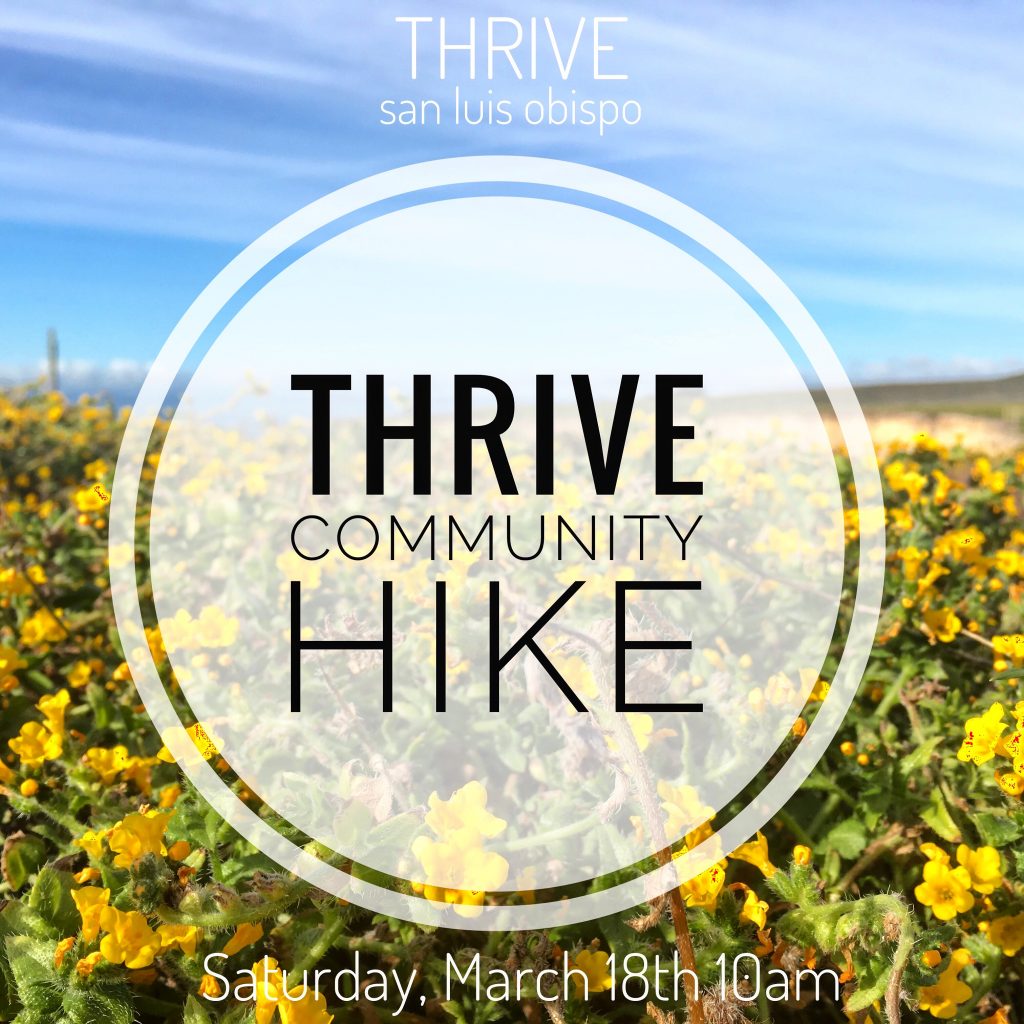
Join us for a Community Hike at Montana de Oro State Park

At Thrive SLO, we try to be intentional about our own self care and we love fostering community with like minded individuals! We’re hoping to create quarterly community events, always free of charge, that allow you to better get to know us and deepen our sense of community in the San Luis Obispo area.

Let’s get together this Saturday for a gentle community hike at Point Buchon in Montaña de Oro! Open to all – no hiking experience necessary. Meet the founders of Thrive San Luis Obispo, psychologists Dr. Sarah Park and Dr. Hannah Roberts, and join our growing community of like-minded Thriving individuals. In celebration of the spring equinox, we’ll be informally chatting about starting fresh and, as always, we’ll be discussing other ways we hope to bring more holistic wellness and thriving to our daily lives.

When: This Saturday, March 18th at 10am.

Where: Point Buchon Trail, Montaña de Oro State Park. To get to the Point Buchon Trail: Take the road into Montaña de Oro State Park ( 3550 Pecho Valley Rd, Los Osos, CA 93402) as far as you can go – the road ends in a parking lot. Park there and meet us at the gate! For more info about the trail, visit: Diablo Canyon Trails

Can’t wait to see you!

"My mission in life is not merely to survive, but to thrive; and to do so with some passion, some compassion, some humor, and some style."
~Maya Angelou

Thrive

Copyright © 2025 · Thrive - San Luis Obispo · Log in