
• Skip to primary navigation
  • Skip to main content
Thrive

Thrive

Evidence based holistic coaching and therapy to unearth what is standing in the way of discovering your best self.

  • Home
  • Meet Us
    • Dr. Hannah Joy Roberts
    • Dr. Sarah Joy Park
    • Ellen M. Jones
    • Laura C. Westmoreland
    • Dr. Heather Lilleston
  • Therapy Services
  • Schedule a Session
  • LGBT+ Resources
  • Blog
  • Contact

Self-Care

Dr. Hannah Roberts · July 9, 2024 ·

Summer Self-Care Series:

An Intro to Mental Wellness

by Taylor Ureta, Cal Poly, San Luis Obispo undergraduate intern, supervised by Dr. Hannah Roberts

Happy summer, Thrivers! Welcome to the first section of the Summer Self-Care Series. With bright skies and sunny days ahead, this series will highlight the perfect opportunity to prioritize summer self-care. Here at Thrive, we emphasize that alongside therapy, self-care is crucial for effectively managing many challenges, especially anxiety and trauma.  

What Is Self-Care?

Self-care involves intentional practices to restore one’s physical and emotional health to manage stress and promote overall well-being (Bible, 2017; Schmutte, 2017). From journaling to hiking, self-care includes anything you do to keep yourself mentally, physically, or spiritually healthy. Doing acts of self-care might seem simple enough, but in the hustle and bustle of everyday life, self-care can be easy to overlook. Between school deadlines and work obligations, carving out time for yourself can feel like a burden. However, self-care is not just about pampering yourself; it’s about taking all the necessary steps to ensure your physical and mental health are balanced. By integrating self-care practices into your routine, you can reduce stress, increase energy levels, and enhance your ability to cope with daily challenges. 

How Does Summer Self-Care Impact My Mental Health?

Self-care can significantly impact your mental health and may act as a “personal medicine” to help decrease symptoms and improve your overall mood and well-being (Bible, 2017). For example, self-care activities help to release endorphins, the body’s natural feel-good hormone, boosting your mood and helping you cope with negative emotions. When used effectively, self-care practices can also reduce stress hormones and promote feelings of calm, relaxation, and self-awareness. 

When struggling with anxiety and trauma, self-care can act as a protective measure against the negative effects of these conditions. Practicing regular self-care acts like deep breathing techniques or muscle relaxation can equip you with tools to manage anxiety symptoms like panic attacks, racing thoughts, and physical tension. Self-care activities that promote relaxation and self-awareness can also help you regulate emotions that may accompany anxiety and trauma. 

Ultimately, self-care can be an effective way to maintain your health and well-being. Alongside therapy, effective self-care monitoring and management can help you gain a better understanding of your symptoms and how to address them (Riegel, 2021).

How Do I Start Incorporating Self-Care Into My Routine?

The key to summer self-care is exploring different practices and identifying those that resonate with your individual needs and abilities. What works for one person might not work for another. While some people find comfort in meditation, others may need the energy boost of a group fitness class. Self-care practices can also range from activities that give life meaning or purpose to spending time in nature or with loved ones. 

Now think to yourself: “what makes me feel good?” “What helps me relax?” 

Maybe you thought about how journaling before bed every night helps you unwind, or how going for a walk around your neighborhood gives you a great boost of energy. Either way, when you find those little acts of self-care, you should start incorporating them into your daily or weekly routine. Figuring out the most effective acts of self-care for yourself will help promote consistency and lead to more positive outcomes. 

Why Is Summer the Perfect Opportunity for Self-Care?

Whether it’s enjoying sunlight with mood-boosting vitamin D, engaging in outdoor exercises, or simply taking time off to recharge, summer provides great moments to prioritize your mental and physical well-being. It’s the perfect time to establish and reinforce healthy habits that can benefit you throughout the year.

In the next few weeks, we’ll discuss how summer self-care approaches that support physical wellness can improve your overall health, especially when managing anxiety and trauma (Schmutte et al., 2017). Starting with the importance of sleep, we’ll delve deeper into specific self-care practices to improve your mental and physical well-being. 

See you next week and happy summer!

Have more questions or feel ready to start therapy in California today? Schedule a session with one of our therapists! You can schedule online here!

We hope you enjoyed this blog post! Have more topics you’d like us to blog about? Contact us and we’ll be sure to include your topic in a future post.

References

Bible, L. J., Casper, K. A., Seifert, J. L., & Porter, K. A. (2017). Assessment of self-care and 

medication adherence in individuals with mental health conditions. Journal of the American Pharmacists Association: JAPhA, 57(3S), S203–S210.e3. https://doi.org/10.1016/j.japh.2017.02.023

Riegel, B., Dunbar, S. B., Fitzsimons, D., Freedland, K. E., Lee, C. S., Middleton, S., Stromberg, A., Vellone, E., Webber, D. E., & Jaarsma, T. (2021). Self-care research: Where are we 

now? Where are we going? International Journal of Nursing Studies, 116. https://doi-org.calpoly.idm.oclc.org/10.1016/j.ijnurstu.2019.103402

Schmutte, T., Davidson, L., & O’Connell, M. (2018). Improved sleep, diet, and exercise in adults 

with serious mental illness: Results from a pilot self-management intervention. Psychiatric Quarterly, 89(1), 61–71. https://doi-org.calpoly.idm.oclc.org/10.1007/s11126-017-9516-9
Dr. Hannah Roberts · April 25, 2024 ·

How To: Have Better Boundaries with Your Smartphone

“Almost everything will work again if you

unplug it for a few minutes,

including you.”

~Anne Lamott

by Gavin Hannegan, Cal Poly, San Luis Obispo undergraduate intern, supervised by Dr. Hannah Roberts

Every Sunday morning, my iPhone sends me a notification reviewing my average screen time for the week (for some reason, I always get the message at exactly 9:13am). Some weeks I feel proud of the number. A lower screen time usually means that I had a productive week and that most of the time spent on my phone was used for school- or work-related reasons. Other weeks I’m not as proud. A decision to take a quick TikTok break may have turned into an hour-long escape from my responsibilities. Weeks like that make me feel guilty, that I should have never opened those apps to begin with. But phones aren’t necessarily a “bad thing.” The key factor is how you use your phone. 

I’m not going to tell you to throw your phone in the garbage can. Not only is it unrealistic to quit your phone usage cold turkey, but it’s also one of the hardest ways to practice self-control related to screen-time (Brevers & Turel, 2019). Smartphones have become an essential component of modern life. They are an efficient way to communicate with friends, family, and even our employers. For college students who are away from home, smartphones may be one of the only ways we are able to check in with our loved ones. The convenience of apps like GPS, calendars, and mobile delivery services are incredibly valuable for the working individual. You may even be reading this blog post on a mobile device. But there are evidence-based ways to enjoy our phones in moderation, to mitigate the health risks that increase the more time we spend scrolling. It can be hard to say “no” to your phone, so here are some recommendations for creating a more healthy relationship with your cellular device.

Set Screen Time Goals

Be specific and realistic with how much time you want to spend on your phone. Account for what you typically do with your phone on a given day. Consider your current average screen time as a baseline. Based on a sample of college students, your daily screen time should be no more than 5 hours. From 5 hours onward, each successive hour spent on phone usage will increase the risk of depressive symptoms by 20% (Rosenthal et al., 2021). If your daily screen time tends to be more than 5 hours, take a look in your phone’s settings to see a breakdown of how frequently you use each app. This will help you identify some of the “problem areas” and will allow your goals to be more concrete. On Apple devices, you can click Settings > Screen Time > App Limits to determine how much time your phone will allow you to spend on a particular set of apps.

Regulate the Amount of Notifications You Receive per Day

Some apps may send too much spam, so it’s easy to turn notifications off for those specific cases, or delete those apps entirely. But what about messages that you don’t want to miss, like a text from Mom or an important update in the group chat? One study recommends a technique called batching, which is where your notifications appear at set times throughout the day. When notifications are scheduled to appear 3 times a day, phone users report higher levels of well-being compared to those who did not regulate their notifications and those who turned off all of their notifications. Unpredictable notifications can be distracting, while a long-term “Do Not Disturb” setting can actually increase anxiety through the fear of missing out (FOMO) (Fitz et al., 2019). To batch your notifications on an Apple device, go to Settings > Notifications > Scheduled Summary.

Limit Phone Usage Especially Before Sleep

The best time to start implementing these strategies is before your bedtime. Sleep is crucial for the regulation of our body and mind, but the use of our phones even an hour before we rest our eyes can disrupt this regulation. This is because the blue light emitted from phones slows the production of melatonin, a hormone involved in maintaining our circadian rhythm. If our circadian rhythm is disrupted, then we have a harder time falling and staying asleep, and we also feel more groggy and tired during the day (Cajochen et al., 2011). As screen time goes up, our sleep quality goes down. Over time, the worse our sleep becomes, the more likely we are to experience a number of negative health outcomes such as obesity, feelings of depression, and strokes (Christensen et al., 2016). While an eventual goal may be to cut phone usage well before we sleep, there are some ways to start smaller. You can reduce the blue light on Apple devices by going to Settings > Display & Brightness > Night Shift, which will make your screen have a warmer tone as the day gets darker. Another tip is to put your phone away before beginning your nighttime routine. This will allow you to direct all of your attention on your skincare, for example, without feeling distracted by your phone. Lastly, leave your phone out of reach while you sleep to reduce any temptations.

Spend Time with Your Friends Instead of Your Phone

This is not the same as interacting with your friends on social media platforms. When we feel the impulse to scroll on social media, it’s often because we feel bored, lonely, or want to suppress our FOMO. And these feelings arise out of a need for social and psychological stimulation. What’s ironic, though, is that when we resort to our smartphones to attempt to gain that stimulation, we effectively reject the stimulation that we would receive–and should be receiving–from in-person interactions (Gao et al., 2023). There’s a term for this process: phubbing. Phubbing is a portmanteau of the words “phone” and “snubbing”, referencing how a person will choose to focus on their phone rather than on the person they’re having a conversation with (Gao et al., 2023). But phubbing doesn’t give us the stimulation that we’re looking for. In fact, it damages our social relationships. Phubbing can lower the relationship quality of romantic couples by making partners feel excluded, ignored, and less intimate (Beukeboom & Pollmann, 2021). Our phones cannot be a substitute for healthy social interaction. 

No phone setting this time; just make plans with your friends! You may have busy schedules with school or work, but just a quick lunch break or a walk around the park will help you feel socially connected. These activities can satisfy your needs and take up the time that you may have otherwise spent on your phone. Even if you bring your phone to a social event, you can still prioritize your friend group by watching videos or looking up information together on one device (Beukeboom & Pollmann, 2021). 

We hope these tips give you a variety of options to tailor your phone usage to your individual lives. When you see that screen time report on Sunday morning, be proud of the work you’ve put in to find that healthy balance. Feel free to share some of your favorite strategies with us, we’d love to hear from you!

Have more questions or feel like you need therapy? Schedule a session with one of our therapists today! You can schedule online here!

We hope you enjoyed this blog post! Have more topics you’d like us to blog about? Contact us and we’ll be sure to include your topic in a future post!

References

Beukeboom, C. J. & Pollmann, M. (2021). Partner phubbing: Why using your phone during interactions with your partner can be detrimental for your relationship. Computers in Human Behavior, 124, 1-11. https://doi.org/10.1016/j.chb.2021.106932

Brevers, D. & Turel, O. (2019). Strategies for self-controlling social media use: Classification and role in preventing social media addiction symptoms. Journal of Behavioral Addictions, 8(3), 554-563. https://doi.org/10.1556/2006.8.2019.49

Cajochen, C., Frey, S., Anders, D., Späti, J., Bues, M., Pross, A., Mager, R., Wirz-Justice, A., & Stefani, O. (2011). Evening exposure to a light-emitting diodes (LED)-backlit computer screen affects circadian physiology and cognitive performance. Journal of Applied Physiology, 110(5), 1432-1438. https://doi.org/10.1152/japplphysiol.00165.2011

Christensen, M. A., Bettencourt, L., Kaye, L., Moturu, S. T., Nguyen, K. T., Olgin, J. E., Pletcher, M. J., & Marcus, G. M. (2016). Direct measurements of smartphone screen-time: Relationships with demographics and sleep. PLoS ONE, 11(11), 1-14. https://doi.org/10.1371/journal.pone.0165331

Fitz, N., Kushlev, K., Jagannathan, R., Lewis, T., Paliwal, D., & Ariely, D. (2019). Batching smartphone notifications can improve well-being. Computers in Human Behavior, 101, 86-84. https://doi.org/10.1016/j.chb.2019.07.016

Gao, B., Liu, Y., Shen, Q., Fu, C., Li, W., & Li, X. (2023). Why cannot I stop phubbing? Boredom proneness and phubbing: A multiple mediation model. Psychology Research and Behavior Management, 16, 3727-3738. https://doi.org/10.2147/PRBM.S423371

Rosenthal, S. R., Zhou, J., & Booth, S. T. (2021). Association between mobile phone screen time and depressive symptoms among college students: A threshold effect. Human Behavior and Emerging Technologies, 3(3), 432-440. https://doi.org/10.1002/hbe2.256

Dr. Hannah Roberts · April 18, 2024 ·

Nature Therapy

“Those who contemplate the beauty of the earth

find reserves of strength

that will endure as long as life lasts.”

— Rachel Carson

by Gavin Hannegan, Cal Poly, San Luis Obispo undergraduate intern, supervised by Dr. Hannah Roberts

In honor of Earth Day, we want to highlight one of the unique services we offer here at Thrive SLO: nature therapy. Is your home too distracting to hold a virtual therapy session? Do you feel most calm when you’re connecting with the trees and plants? Or maybe you haven’t gotten your steps in for the day. Nature therapy may be the perfect fit for you! Read on to learn more about the benefits of nature therapy and where to meet your therapist for your first outdoor session.

What is Nature Therapy?

If you’ve ever heard of the term “talk therapy,” nature therapy is essentially “walk and talk” therapy. Sometimes called eco-therapy or outdoor therapy, nature therapy allows you and your therapist to meet outside the walls of a typical office setting. You and your therapist will agree on a quiet, open space to meet, such as a park or a forest. Then, the two of you will spend the session working through any concerns you wish to discuss. Feel free to get up and stroll through the environment, or find a comfortable spot to take a breather. There are a number of ways to personalize your nature therapy experience to best suit your needs. Nature therapy can be used alongside a variety of evidence-based practices such as CBT and Gestalt therapy (Cooley et al., 2020). If you’re interested in being more involved with the environment, you may also want to look into horticultural therapy or wilderness therapy. Through nature therapy, you can work towards self-awareness while getting some fresh air and movement.

Why Nature Therapy?

Being in nature can help soothe the body and mind. One study found that undergraduate college students reported lower levels of stress and higher measures of well-being when they engaged in outdoor physical activity, including walking and hiking. By actively interacting with nature, college students can relieve themselves of the stress that they may experience as a result of their day-to-day responsibilities and commitments (Holt et al., 2019). Similarly, spending even just 30 minutes on “green” activities such as gardening or creating art from natural materials can help reduce symptoms of depression or anxiety and protect against future mental health concerns (Coventry et al., 2021). Nature provides a readily accessible form of self-care.

Nature therapy takes the calming effects of nature and combines it with the empowering qualities of therapy. Compared to a control group, those who participated in a walk and talk therapy intervention reported nearly twice as many positive outcomes, ranging from higher job satisfaction to lower rates of burnout (van den Berg & Beute, 2021). The natural environment can help separate yourself from the confines of your work environment. A distinct advantage of nature therapy is its ability to establish a more equitable relationship between therapists and clients. Rather than taking place in the therapist’s office, which may feel intimidating to new clients, both the therapist and the client work together to find an outdoor space for themselves (Cooley et al., 2020). Choosing a location not only fosters healthy communication between you and your therapist, but it’s also an opportunity to bond before you even meet in-person. The therapeutic relationship works best when both parties feel comfortable; spending time outdoors can help you better establish that comfort with your therapist.

Where Can I Meet My Therapist for a Nature Therapy Session?

San Luis Obispo is home to some beautiful outdoor areas that are ideal for a nature therapy session. Montaña de Oro has several great hiking trails to choose from, or you can sit right at the coastline and enjoy the sounds of the ocean. Morro Rock and Avila are some other notable locations to meet up for a beach walk. The Monarch Butterfly Grove in Pismo can feel lively when all of the monarch butterflies migrate to the tall trees during the winter season. The Bob Jones Trail and Meadow Park are great choices if you’re looking for a light walk on a paved trail, or if you want to ease your way into nature therapy. If your therapy sessions are virtual, remember that you can always sit outside for your therapy session or take your therapist along for a walk. Still not sure which place to visit? Reach out to one of our therapists for their recommendations. We can’t wait for you to enhance your therapy experience through the healing properties of nature.

Have more questions or feel like you need supportive therapy? Schedule a session with one of our therapists today! You can schedule online here!

We hope you enjoyed this blog post! Have more topics you’d like us to blog about? Contact us and we’ll be sure to include your topic in a future post!

References

Cooley, S. J., Jones, C. R., Kurtz, A., & Robertson, N. (2020). ‘Into the Wild’: A meta-synthesis of talking therapy in natural outdoor spaces. Clinical Psychology Review, 77, 1-14. https://doi.org/10.1016/j.cpr.2020.101841

Coventry, P. A., Brown, J. V. E., Pervin, J., Brabyn, S., Pateman, R., Breedvelt, J., Gilbody, S., Stancliffe, R., McEachan, R., & White, P. C. L. (2021). Nature-based outdoor activities for mental and physical health: Systematic review and meta-analysis. SSM – Population Health, 16, 1-14. https://doi.org/10.1016/j.ssmph.2021.100934

Holt, E. W., Lombard, Q. K., Best, N., Smiley-Smith, S., & Quinn, J. E. (2019). Active and passive use of green space, health, and well-being amongst university students. International Journal of Environmental Research and Public Health, 16(3). https://doi.org/10.3390/ijerph16030424

van den Berg, A. E. & Beute, F. (2021). Walk it off! The effectiveness of walk and talk coaching in nature for individuals with burnout- and stress-related complaints. Journal of Environmental Psychology, 76, 1-11. https://doi.org/10.1016/j.jenvp.2021.101641

Dr. Hannah Roberts · April 4, 2024 ·

Accessing Therapy Beyond Crisis Situations

“When we are no longer able to change a situation,

we are challenged to change ourselves.”

~Viktor E. Frankl

by Gavin Hannegan, Cal Poly, San Luis Obispo undergraduate intern, supervised by Dr. Hannah Roberts

There’s a misconception that therapy should be complete once you start “feeling better.” It’s important to recognize your progress, but there shouldn’t be a deadline to feel your best. Mental health is complex, and oftentimes, your progress doesn’t follow a linear fashion. One week, you might feel stable and secure, and then the next week, you might feel like you fell a few steps back. Don’t worry, these ups and downs are perfectly normal. But what if you’ve been “feeling better” for months, or even years? Or, what if you’ve never had a mental health crisis? Therapy can still be a valuable resource! No matter your background or previous experiences, you are deserving of this kind of care. 

Here are 3 reasons for considering therapy beyond the context of a crisis:

#1: The Brain Doesn’t Function Properly While Under Distress

Chronic stress can make your body feel like it is in a never-ending fight-or-flight state. This is because of how chronic stress delays two important parts of the brain: the prefrontal cortex and the neurotransmitter GABA. The prefrontal cortex is responsible for processes such as cognitive planning and self-regulation, while GABA produces a calming effect meant to counteract stress. Because of these delays, traumas or other ongoing adversities can impair daily functioning. For example, those who experience such stressors have significant declines in working memory, a component of short-term memory that allows you to actively process information. As we age, our working memory skills decrease naturally, but chronic stress accelerates this process (Gandy et al., 2024). COVID-19 has contributed to global increases in chronic stress, which has subsequently produced similar accelerated aging effects in adolescents (Gotlib et al., 2022). Our bodies are not equipped to handle such extreme amounts of stress in small amounts of time, which can increase the risk of cognitive and health-related deficits.

Therapy can help us navigate these stressors by providing coping strategies. However, deficits in working memory impair the learning of these strategies, and delays in the prefrontal cortex and the firing of GABA impair the proper use of these strategies. This is not to say that therapy wouldn’t be helpful to someone actively experiencing a crisis. Rather, you don’t need a crisis to justify therapy. In fact, you might be more receptive to these strategies if they are learned before a crisis emerges.

#2: Therapy Can Be a Protective Measure Against Future Mental Health Crises

It’s never too early to consider therapy. We may not be able to predict when we will encounter another crisis, but we can take action to better prepare ourselves for one. This doesn’t mean that you need to be in therapy for the rest of your life. But attending therapy even when you feel stable can help you maintain that stability over time. One way that therapy operates as a maintenance tool is by teaching skills such as mindfulness, which can help reduce symptoms of anxiety and depression (Eilert et al., 2021). Your therapist can work with you to develop mindfulness strategies that fit best for you. These can include daily affirmations, breathing exercises, or meditations. Additionally, compared to brief forms of therapy (~6 months), long-term therapy, which we often prefer at Thrive SLO (~3 years), is slightly more effective in reducing depressive symptoms and improving daily functioning (Knekt et al., 2016). For some individuals, short-term therapy may not be enough time to implement maintenance strategies and measure their effects, especially for those who are only focused on overcoming a chronic stressor. There isn’t necessarily an ideal length of therapy; it depends on the goals that you set with your therapist. You might have multiple short-term goals (e.g., wanting to be social at an upcoming party) or one overarching goal (e.g., adjusting to daily life after an unexpected loss). Each step you take towards reaching these goals can have a strong positive impact on your well-being, and the lessons you learn can be applied to new goals or concerns.

#3: Long-term Therapy Gives You More Time to Build an Alliance With Your Therapist

Another valuable aspect of therapy is that you have someone to talk to who knows you well. Someone who is unbiased, who recognizes your potential, and who encourages your personal growth. In one meta-analysis that reviewed over 30,000 therapy clients, the relationships those clients had with their therapists were consistently associated with positive outcomes such as symptom reduction (Flückiger et al., 2018). Your therapist can be a consistent form of support. Even having one such person in your life can make a difference. 

As with many other kinds of relationships, though, it can take some time for you and your therapist to form a close bond. You may be hesitant to be vulnerable to a new person in your life, while your therapist has to adapt to your level of comfort with certain topics or situations. If you’re experiencing a crisis, then your typical responses to these topics may be exaggerated or distorted. You could be more on edge, less willing to disclose personal information, or you could be more likely to think irrationally. As a result, there could be misinterpretations between the two of you that can threaten the therapeutic alliance. By spending more time with your therapist, they will have more opportunities to learn about who you are outside the context of a crisis situation. Remember that crises are temporary, and the skills you develop with your therapist can help protect you not just against the crisis you’re currently facing, but also against many other future challenges. There is no concern too small for therapy.

Have more questions or feel like you need supportive therapy? Schedule a session with one of our therapists today! You can schedule online here!

We hope you enjoyed this blog post! Have more topics you’d like us to blog about? Contact us and we’ll be sure to include your topic in a future post!

References

Eilert, N., Wogan, R., Adegoke, A., Earley, C., Duffy, D., Enrique, A., Palacios, J., Timulak, L., & Richards, D. (2023). The relationship between posttherapeutic cognitive behavior therapy skills usage and follow-up outcomes of internet-delivered cognitive behavior therapy. Journal of Clinical Psychology, 79(1), 55-67. https://doi.org/10.1002/jclp.23403

Flückiger, C., Del Re, A. C., Wampold, B. E., & Horvath, A. O. (2018). The alliance in adult psychotherapy: A meta-analytic synthesis. Psychotherapy, 55(4), 316-340. https://doi.org/10.1037/pst0000172

Gandy, H. M., Holis, F., Hernandez, C. M., & McQuail, J. (2024). Aging or chronic stress impairs working memory and modules GABA and glutamate gene expression in prelimbic cortex. Frontiers in Aging Neuroscience, 15. https://doi.org/10.3389/fnagi.2023.1306496

Gotlib, I. H., Miller, J. G., Borchers, L. R., Coury, S. M., Costello, L. A., Garcia, J. M., & Ho, T. C. (2023). Effects of the COVID-19 pandemic on mental health and brain maturation in adolescents: Implications for analyzing longitudinal data. Biological Psychiatry Global Open Science, 3(4), 912-918. https://doi.org/10.1016/j.bpsgos.2022.11.002

Knekt, P., Virtala, E., Härkänen, T., Vaarama, M., Lehtonen, J., & Lindfors, O. (2016). The outcome of short- and long-term psychotherapy 10 years after start of treatment. Psychological Medicine, 46(6), 1175-1188. https://doi.org/10.1017/S0033291715002718

Dr. Hannah Roberts · November 21, 2017 ·

Express Your Gratitude

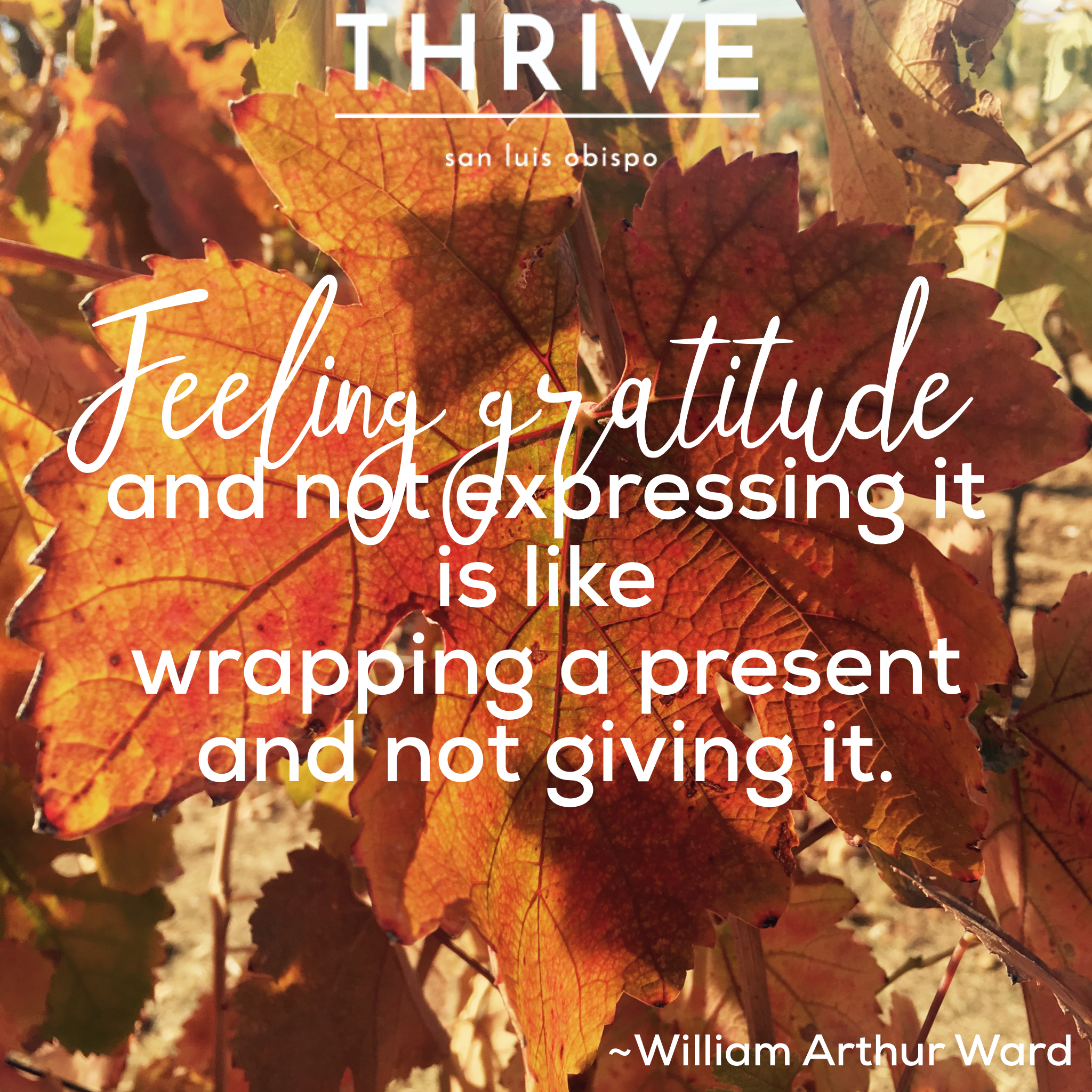
“Feeling gratitude and not expressing it is like wrapping a present and not giving it.” ~William Arthur Ward

Let’s Check In!

Are you feeling the gratitude this month? How did you do with last week’s challenge to write down two things you are grateful for each day? Did you find it easy? Hard? Were you grateful for similar things each day? And have you checked how you score on the Gratitude Questionnaire? Were you surprised with your score? Have you improved your sense of gratitude this month? This week, we’ll take our gratitude practice to the next level, by expressing our gratitude to others. This is perfect for the week of Thanksgiving, where you’ll have ample opportunities to share with the people you love.

Defining Gratitude

Google dictionary defines gratitude as “the quality of being thankful; readiness to show appreciation for and to return kindness.”

Synonyms for gratitude include:

  • gratefulness
  • thankfulness
  • thanks
  • appreciation
  • indebtedness
  • recognition
  • acknowledgment
  • credit

Gratitude is defined as a noun, and that is how we have been addressing it throughout our month of gratitude. It is usually seen as a mood, personality trait, or emotional response to others’ behavior. But it’s closely tied to action – such as expressing gratitude or saying thank you. This week, we’re focusing on the outward expression of our gratitude to others.

Express Your Gratitude

Research shows that the actual expression of gratitude to another human being increases the benefits of the gratitude experience. When we interact with others in positive ways, we release bonding and other positive hormones that help us feel more connected to others. Gratitude helps us be more trusting and more social, and in turn, it appears to deepen our relationships. When we see that we have made someone else feel good, we often get a boost of positive emotions as well. Expressing gratitude has been found to uniquely improve your sense of happiness and reduce your feelings of depression.

Reach Out and Thank Someone

Are you ready for this week’s challenge? Take some time this week to thoughtfully express your gratitude to another person. This is more than just a cursory “thank you” –  sit down with the person and tell them how they made you feel. Maybe you won’t see the person that you want to express your gratitude to in the next week? No worries! You can write a letter (or …let’s be real: an email, or text, or maybe even a snap?). For those of us who have difficulty expressing ourselves, it might be easier to express your gratitude in a hand written letter and then deliver it in person. If you can, it helps to be able to see the person receive your feedback.  Let the person know exactly what they did and how you benefited from the action. Take a moment to allow you both to savor the experience and reflect on how it feels to express your gratitude.

Let us know how it goes – leave a note in the comments or share on Instagram or Facebook.

And have a wonderful Thanksgiving!

  • « Go to Previous Page
  • Page 1
  • Page 2
  • Page 3
  • Page 4
  • Page 5
  • Go to Next Page »
"My mission in life is not merely to survive, but to thrive; and to do so with some passion, some compassion, some humor, and some style."
~Maya Angelou

Thrive

Copyright © 2025 · Thrive - San Luis Obispo · Log in